Thanks to the numerous combinations of its 396 different types of olfactory receptors, most of which exhibit cross-reactivity to odor molecules, the human nose is capable of analyzing over a billion olfactory stimuli. In order to mimic its performance, or even surpass it (with continuous operation or the detection of hazardous gases imperceptible to humans), and to measure these odors or chemical substances present in the air in an objective and reproducible manner, artificial noses are being developed. Among these artificial noses, electronic noses (using sensors based on inorganic or organic materials) represent the least expensive and most stable systems. However, a problem of selectivity, linked to the sensor’s weak interactions with odor molecules present in the air, limits their performance.
For the first time, researchers at SyMMES/CREAB came up with the innovative idea of combining, on a single chip, "generalist" peptides with cross-reactivity and "specialist" peptides with specific affinities for targeted odor molecules.
To achieve this, using a model target for proof of concept, in collaboration with the LIPhy laboratory (CNRS/UGA), they carried out a large-scale screening using the "phage display*" technique, enabling them to identify five highly specific peptides exhibiting optimal sensitivity and selectivity for air pollutants BTEX (Benzene – Toluene – Ethylbenzene – Xylenes).
They demonstrated that the electronic noses produced by adding these new "specialized" peptides were able of distinguishing between pure volatile organic compounds from different chemical families, as well as complex mixtures, with great precision and across a range of concentrations, paving the way for the development of a new generation of biomimetic electronic noses with unprecedented performance.
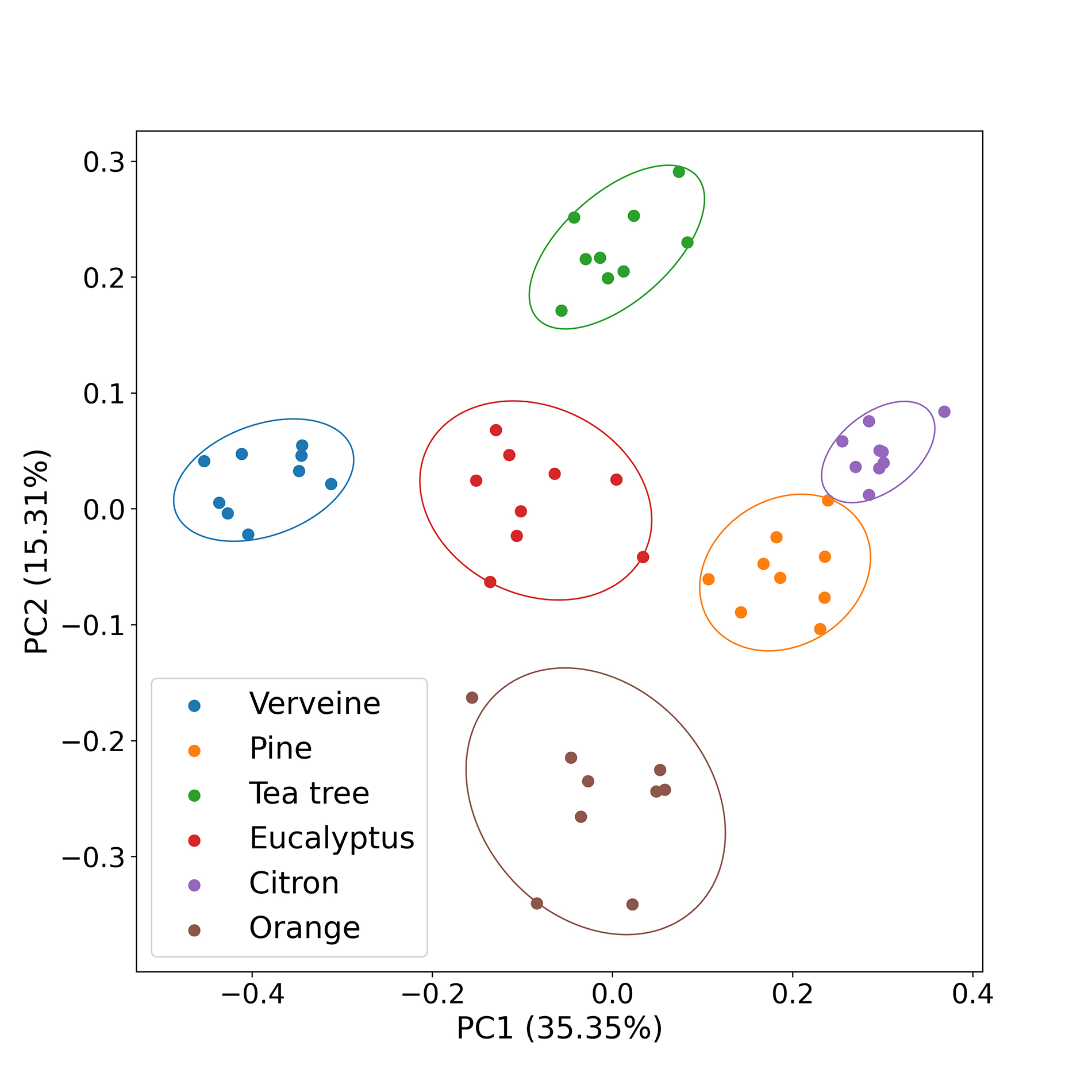
Principal component analysis* of six essential oils used as complex mixtures, showing how the samples cluster or separate according to their chemical signatures, and thus demonstrating the discrimination performance of the biomimetic electronic nose, which combines cross-reactive ‘generalist’ peptides with more selective ‘specialist’ peptides.
© CEA-Irig/SyMMES/CREAB/Y. Hou-Broutin
This pioneering biomimetic electronic nose strategy, which combines these two types of peptides within a single device, represents a significant step forward in the development of artificial olfactory systems, paving the way for versatile applications in environmental monitoring, food quality control, and the fields of health and safety.
Phage display* : A technique developed in the 1980s that enables the selection of peptides capable of binding specifically to a given target. This technique allows for the large-scale screening of peptides (a library of 109 bacteriophages displaying different peptides).
Principal component analysis*: allows samples to be categorized relative to one another according to principal components (PCs). Each point represents a sample, and its position indicates how closely it resembles or differs from the others. The principal components summarize the information contained in many initial variables (responses to different peptides). The first principal component (PC1) combines the variables where the difference between samples is greatest. The second principal component explains the second largest source of variation.
Tutelles UMR : SyMMES (CEA, CNRS, UGA, Grenoble INP - UGA)
Fundings
: ANR Siena (ANR-21-CE21-0009)
Collaborations : LIPhy (CNRS/UGA, Grenoble)