The ubiquity of plastic waste in the environment leads to the formation of micro- and nanoplastics (MNP), which we ingest daily through water and food. Their impact on human health—particularly on the intestinal epithelium and in vulnerable populations, such as people with
Crohn's disease*—remains a major concern. Several studies conducted at
CEA-Irig have compared the cellular effects of conventional polymers (PET,
PS) and biodegradable polymers (PLA,
PCL)—in their native form or artificially aged under environmental conditions—to assess their potential toxicity in humans.
Using
in vitro models that replicate the intestinal epithelium of healthy subjects or those with a genetic susceptibility to Crohn's disease, the researchers demonstrated that MNPs accumulated significantly in the cells (up to 20% for PET). Despite this accumulation, only very low
acute toxicity* was observed
in vitro, regardless of whether the polymers were biodegradable or not. The study also reveals that PCL degrades inside the cells and releases oligomers, for which the impact remains limited. Furthermore, weathered particles —simulating their prolonged exposure in the environment— does not increase their toxicity.
In contrast, one of these studies shows that,
in vivo, PS MNPs alter intestinal permeability and cause significant toxicity. These results suggest that the effects of MNPs observed
in vivo would not originate from a response of the intestinal epithelium, but that other intestinal cell lineages or the
microbiota* could be involved. It would be worth using a more complex intestinal model so as to more accurately reproduce
in vivo observations on
in vitro models.
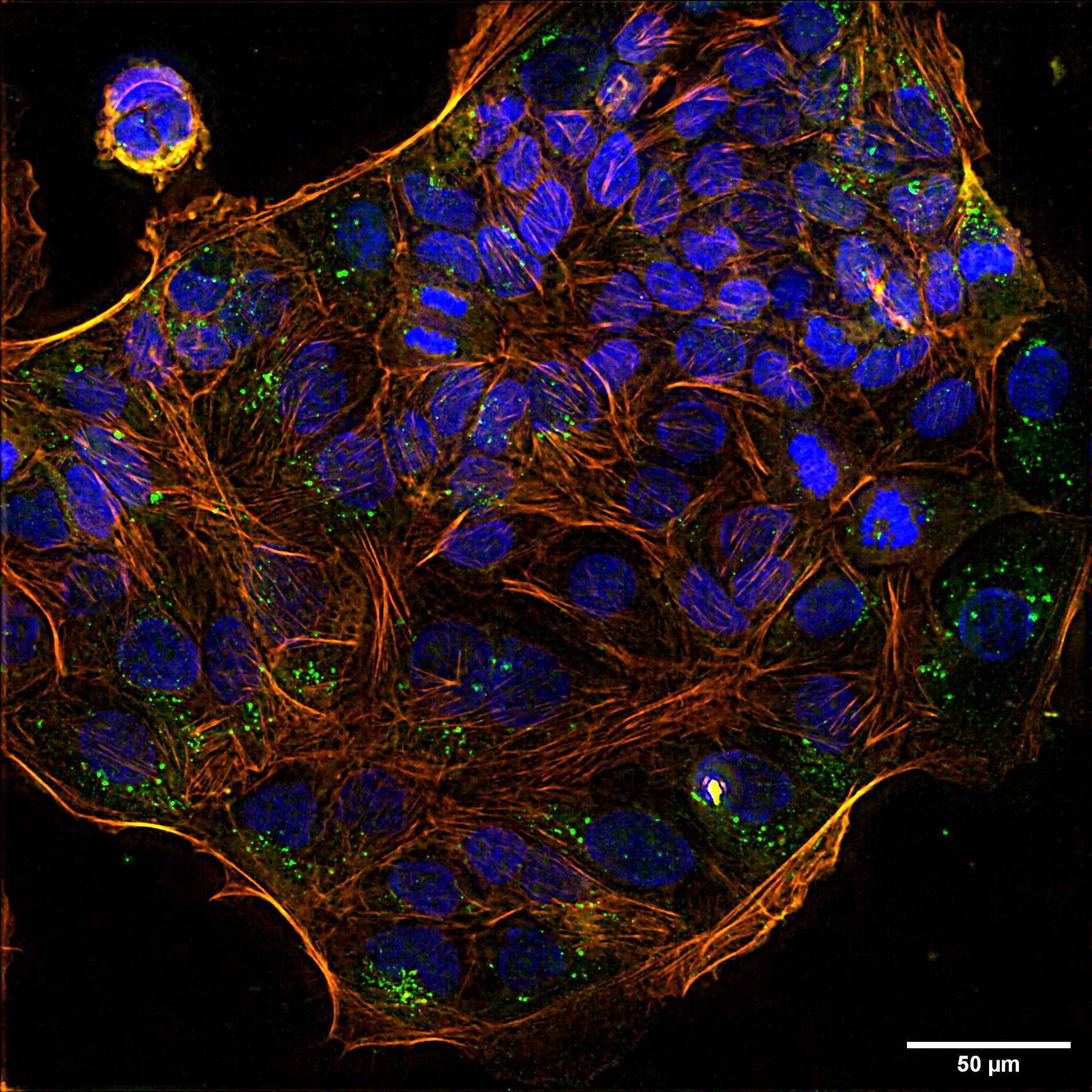
© CEA-Irig/SyMMES/CIBEST
Figure : Fluorescence microscopy image of intestinal epithelial cells exposed to fluorescent PS MNPs. Orange: cytoskeleton, blue: nucleus, green: PS MNPs. Scale bar: 50 µm.
This research provides new insights into the effects of nanoplastics—whether conventional or biodegradable—on the intestinal barrier. While
in vitro models show generally moderate effects,
in vivo experiments reveal greater toxicity, suggesting that other cell types are responsible for the
in vivo observations. Evaluating these effects using primary intestinal cell culture models or
intestinal organoids* could lead to a better understanding of the mechanisms involved. This understanding could then facilitate the development of prevention strategies and, ultimately, appropriate treatment approaches.
Crohn's disease*: chronic inflammatory bowel disease that can impair the barrier function of the intestinal epithelium.
Acute toxicity*: adverse effects (impaired viability) observed following short-term exposure to high doses.
Microbiota*: collection of microorganisms (bacteria, yeasts, etc.) living in the gut. It plays an important role, particularly in digestion.
Intestinal organoids*: three-dimensional structures grown in laboratories that replicate certain characteristics and functions of the gut, allowing researchers to study its functioning under conditions that closely mimic those in the body.
PET : polyethylene terephthalate;
PS : polystyrene;
PLA : polylactic acid;
PCL : polycaprolactone.
Tutelles UMR : CEA, CNRS, UGA, Grenoble-INP (Irig-SyMMES).
Fundings : ANR (PLASTOX), ANSES (EXMINA), PEPR (Recyclage, recyclabilité et ré-utilisation des matières), Union Européenne (PLASTICHEAL).
Collaborations : INSERM Institut de recherche en santé digestive (IRSD), Irig-IBS, Irig-LCBM, Iramis-Lions, Université Autonome de Barcelone.